
Market Overview
| Study Period | 2020 - 2031 |
|---|---|
| Forecast Data Period | 2026 - 2031 |
| Base Year Market Size (2025) | USD 53.88 Billion |
| Market Size (2026) | USD 57.5 Billion |
| Market Size (2031) | USD 75.95 Billion |
| Growth Rate (2026 - 2031) | 5.72% CAGR |
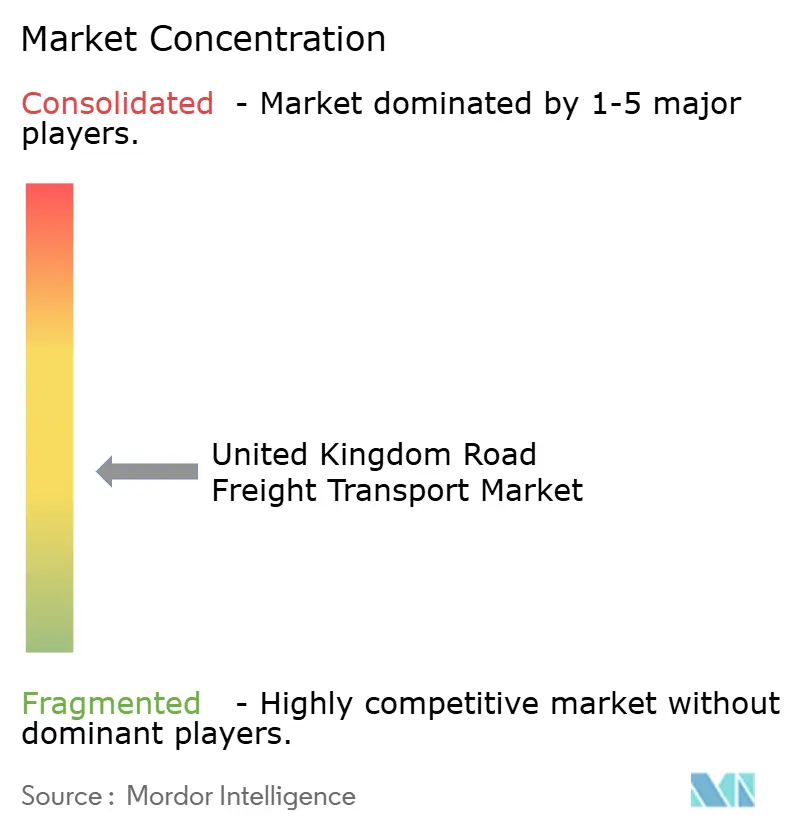
| Market Concentration | Medium |
Major Players *Disclaimer: Major Players sorted in no particular order Image © Mordor Intelligence. Reuse requires attribution under CC BY 4.0. | |
United Kingdom Road Freight Transport Market Analysis by Mordor Intelligence
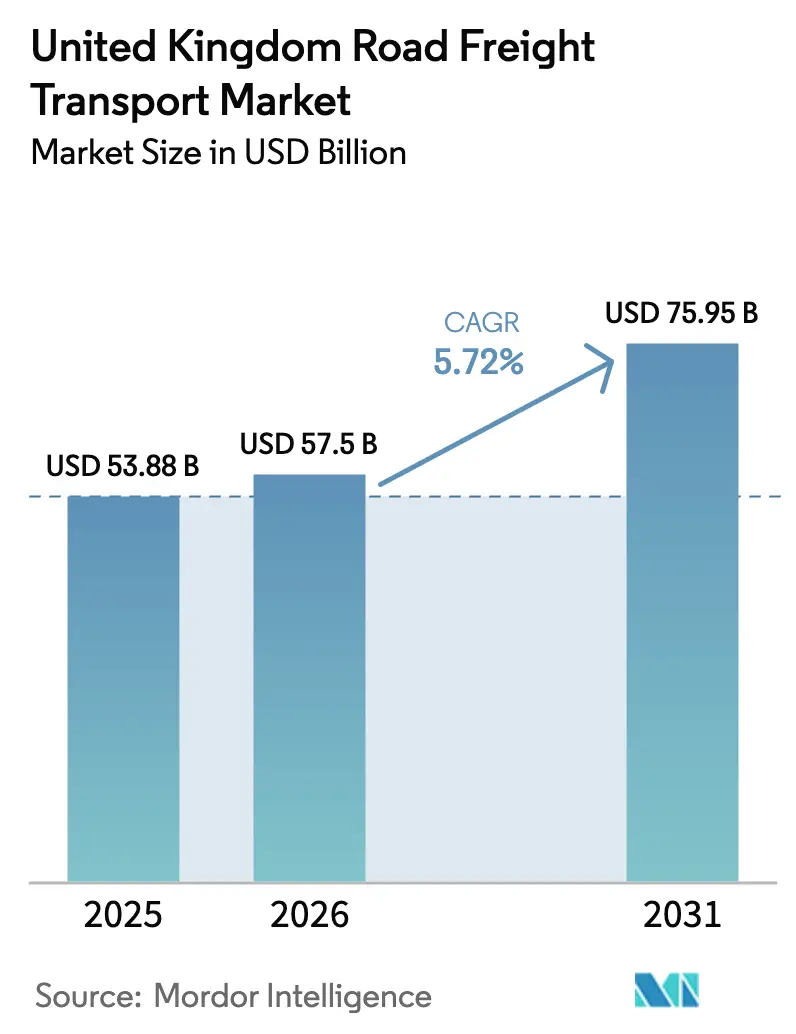
The United Kingdom Road Freight Transport Market size is projected to be USD 53.88 billion in 2025, USD 57.5 billion in 2026, and reach USD 75.95 billion by 2031, growing at a CAGR of 5.72% from 2026 to 2031.
Corporate Scope-3 increasingly shapes carrier selection mandates that reward certified low-carbon fleets with 12-18% rate premiums, while a 60-tons road-train trial produces 15% productivity gains but remains confined to major motorways. Acute shortages of secure HGV parking and a rapid escalation in Golden Triangle warehouse rents are the primary structural brakes on growth, raising operating costs and widening the gap between scale operators and smaller haulers.
Key Report Takeaways
- By end user, manufacturing retained 40.65% of the United Kingdom road freight transport market share in 2025, while wholesale and retail trade is forecast to post the fastest 2.90% CAGR through 2031.
- By destination, international movements delivered a 3.10% CAGR outlook, outperforming domestic freight, despite holding only 34.43% of 2025 volumes after digital border reforms halved border dwell times.
- By truckload, Full-truck-load services accounted for 83.36% of the United Kingdom road freight transport market size in 2025, while Less-than-truckload is forecast to post the fastest 2.93% CAGR through 2031.
- By containerization, non-containerized retained 88.62% of the United Kingdom road freight transport market in 2025, while containerized is forecast to post the fastest 2.67% CAGR through 2031.
- By distance, long-haul routes commanded 71.70% share of the United Kingdom road freight transport market in 2025 and led growth at a 2.74% CAGR on the back of mega-infrastructure material demand.
- By goods configuration, solid goods retained 73.52% of the United Kingdom road freight transport market in 2025, while fluid goods are forecast to post the fastest 2.83% CAGR through 2031.
- By temperature control, non-temperature retained 94.76% of the United Kingdom road freight transport market in 2025, while temperature-controlled is forecast to post the fastest 2.88% CAGR through 2031.
Note: Market size and forecast figures in this report are generated using Mordor Intelligence’s proprietary estimation framework, updated with the latest available data and insights as of January 2026.
United Kingdom Road Freight Transport Market Trends and Insights
Drivers Impact Analysis
| Driver | (~) % Impact on CAGR Forecast | Geographic Relevance | Impact Timeline |
|---|---|---|---|
| Digital border & customs modernization | +1.2% | National, concentrated at Dover, Felixstowe, and Southampton ports | Short term (≤ 2 years) |
| Infrastructure mega-projects | +0.9% | Midlands and South East construction corridors | Medium term (2-4 years) |
| Pharma biomanufacturing clusters | +0.7% | Cambridge, Oxford, Manchester, Greater London | Long term (≥ 4 years) |
| 60-tonne road-train pilot | +0.5% | M1, M6, A1(M) trunk routes | Medium term (2-4 years) |
| Corporate Scope-3 freight procurement shift | +0.4% | National, strongest in London and the South East | Medium term (2-4 years) |
| Circular-economy reverse logistics growth | +0.3% | National, e-commerce fulfillment hubs | Short term (≤ 2 years) |
| Source: Mordor Intelligence | |||
Digital Border & Customs Modernization Speeds Cross-Border Cycles
GVMS and BTOM consolidate declarations into a single digital file processed pre-arrival, allowing 87% of consignments to clear without inspection and cutting crossing times at Dover from 47 minutes to 28 minutes during 2024-2025. The link with the EU’s ICS2 permits advance risk analysis that lowered rejection rates 34%. Temperature-controlled shippers benefit most, avoiding spoilage formerly caused by multi-hour queues. Faster borders also strengthen the United Kingdom road freight transport market by drawing volumes away from air freight on short European lanes. Operators report 6-8% asset-turn increases as tractors previously idling at ports re-enter revenue runs more quickly. Digital declarations further enable smaller haulers to offer international services, broadening competitive intensity inside the United Kingdom road freight transport market[1]European Commission, “Import Control System 2,” ec.europa.eu .
Infrastructure Mega-Projects Swell Construction Freight
HS2 Phase One alone consumes 18 million tons of aggregates and 1.2 million tons of steel through 2028, while the Lower Thames Crossing adds 3 million tons of deliveries through 2030. Government infrastructure budgets average USD 141 billion annually to 2027, ensuring multi-year contract visibility. These projects anchor predictable payloads that encourage fleet renewal into specialized walking-floor and low-loader trailers, raising capital efficiency. Long-haul segments of the United Kingdom road freight transport market capture the bulk of material flows as rail paths remain capacity-constrained. Construction volumes also cushion carriers against retail slowdowns, producing counter-cyclical revenue stability[2]HS2 Ltd., “HS2 Construction Materials and Logistics,” hs2.org.uk.
Rise of Pharma Biomanufacturing Clusters Drives Temperature-Controlled Demand
A EUR 2.8 billion (USD 3.05 billion) investment wave in cell and gene therapy sites sharpens demand for GDP-validated, multi-temperature logistics spanning -80 °C to +25 °C. Faster MHRA approvals attract innovators that require just-in-time bio-input deliveries, elevating service expectations. Temperature-controlled lanes command rates 2.5-3× higher than ambient freight, supporting margin expansion for certified fleets. Dedicated corridors link Cambridge, Oxford, and Manchester plants to Heathrow and national depots, reshaping lane balance within the United Kingdom road freight transport market. Contract durations of 3-5 years with six-figure penalties for temperature breaches incentivize investment in telematics and dual-evaporator trailers.
60-Tons Road-Train Pilot Boosts Trunk-Route Productivity
The extended 18.55 m semi-trailer trial delivers 15% greater payload and 12% lower fuel per ton-kilometer, benefitting consumer packaged goods where volume, not weight, constrains cube-outs. Driver output rises 18-22% on trunk circuits, partially offsetting recruiting shortfalls. Yet only 38% of distribution centers can accept longer combinations, limiting rapid scale-up. Municipalities oppose urban use, so productivity gains remain a trunk-line phenomenon. Even so, operators exploiting the scheme secure rate concessions that differentiate offerings inside the United Kingdom road freight transport market.
Restraints Impact Analysis
| Restraint | (~) % Impact on CAGR Forecast | Geographic Relevance | Impact Timeline |
|---|---|---|---|
| Shortage of secure overnight HGV parking | −0.8% | National, acute on M1, M6, A1 corridors | Short term (≤ 2 years) |
| Logistics real estate scarcity | −0.6% | Golden Triangle: London-Birmingham-Leeds | Medium term (2-4 years) |
| Post-Brexit cabotage limits & visa caps | −0.4% | National, ports, and border crossings | Short term (≤ 2 years) |
| Parts & tire supply disruptions | −0.3% | National, higher on aging fleets | Short term (≤ 2 years) |
| Source: Mordor Intelligence | |||
Shortage of Secure Overnight HGV Parking Meeting EU 561/2006 Rest Rules
Only 11,000 compliant spaces exist for 520,000 HGVs, forcing 68% of drivers into unlawful lay-bys where fines and operator-license sanctions loom. Hotspots on the M1, M6, and A1 experience 4:1 demand-supply gaps that add 8-12% detours for parking searches, trimming driver hours. Re-routing lowers fleet productivity, inflates fuel spend, and erodes service reliability inside the United Kingdom road freight transport market.
Logistics-Real-Estate Scarcity Drives Warehouse Rents Above 12% CAGR.
Golden Triangle rents climbed 12.7% during 2024-2025 as green-belt policy plus 24-month planning cycles choked new builds, leaving only 2,400 acres of developable land. Prime cross-dock sites cost up to USD 19/ft², doubling secondary-market rates. Operators migrate to East Midlands and Yorkshire, adding 15-30 mile stems to final-mile runs that dilute the fuel savings from cheaper leases. The imbalance intensifies consolidation since scale players can internalize elevated rents across higher load factors in the United Kingdom road freight transport market[3]Savills Research, “UK Logistics Real Estate Market Report 2025,” savills.com .
Segment Analysis
By End-User Industry: Pharma Investment Reshapes Freight Mix
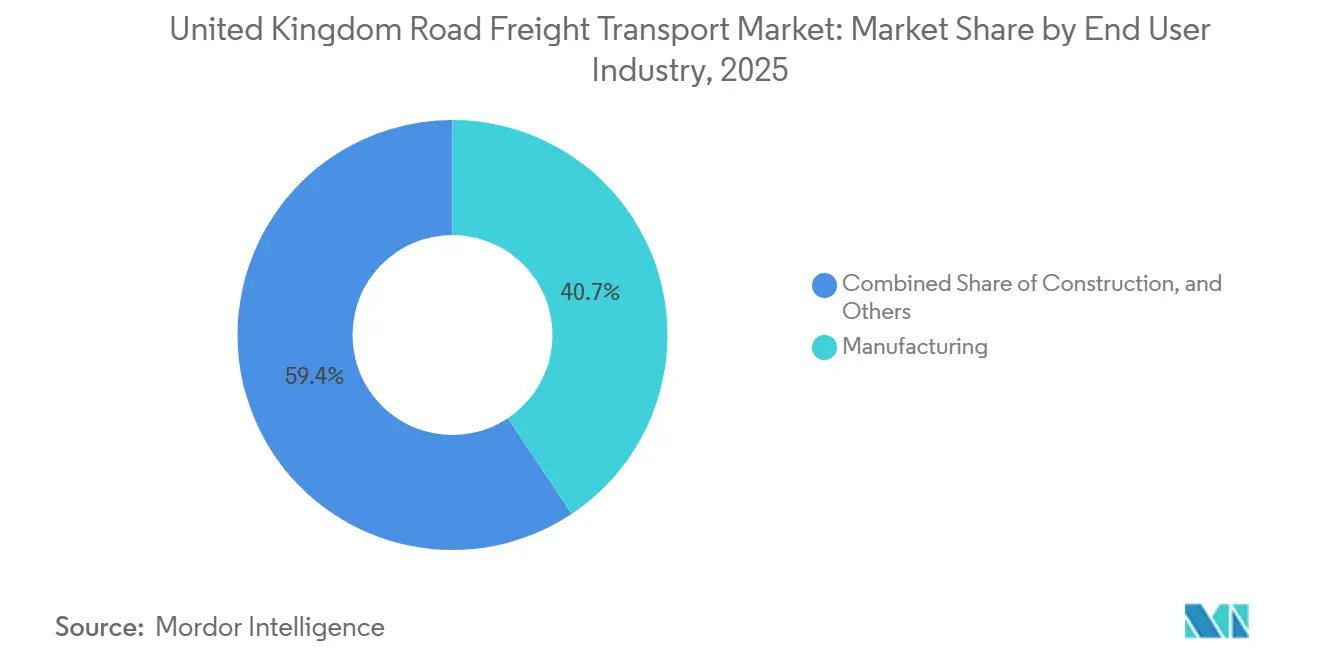
By end user, manufacturing retained 40.65% of the United Kingdom road freight transport market share in 2025, while wholesale and retail trade is forecast to post the fastest 2.90% CAGR through 2031. Manufacturing remained the leading segment, supported by automotive production in the Midlands and the expansion of biopharma clusters, while wholesale and retail growth is being driven by omnichannel models that require more frequent, lower-volume shipments.
Temperature-controlled logistics for advanced therapies continue to support premium services and strengthen pharmaceutical demand. At the same time, infrastructure projects such as HS2 and the Lower Thames Crossing are boosting the movement of construction materials, while post-Brexit shifts toward domestic sourcing in agriculture and ongoing North Sea decommissioning sustain specialized freight demand. Emerging data center developments along the London–Dublin corridor are also creating opportunities for high-value, time-sensitive transport, encouraging fleets to expand service capabilities.
Note: Segment shares of all individual segments available upon report purchase
Get Detailed Market Forecasts at the Most Granular Levels
Download PDF
By Destination: Digital Borders Catalyze International Expansion
By destination, international movements delivered a 3.10% CAGR outlook, outperforming domestic freight despite holding only 34.43% of 2025 volumes after digital border reforms significantly reduced border delays. Domestic haulage continued to dominate the market, supported by dense population centers and the country’s geographic structure, while improving border efficiency and Freeport incentives are encouraging more businesses to participate in cross-border trade.
Domestic operations are also benefiting from productivity gains on key motorway corridors, helping offset ongoing driver shortages. However, regulatory constraints such as cabotage limits and added compliance complexities in Northern Ireland are weighing on cross-Channel margins. In response, some shippers are increasingly adopting unaccompanied trailer solutions via ferry to improve flexibility and reduce scheduling risks.
By Truckload Specification: Longer Trailers Lift FTL Economics
By truckload, Full-truck-load services accounted for 83.36% of the United Kingdom road freight transport market size in 2025, while Less-than-truckload is forecast to post the fastest 2.93% CAGR through 2031. Full-truck-load activity continues to dominate, supported by large-scale retail replenishment, automotive just-in-sequence supply chains, and construction logistics, with higher payload efficiencies further strengthening its cost advantage on longer routes.
Less-than-truckload is expanding due to the rise in e-commerce returns and increasing shipment fragmentation driven by circular economy practices. The adoption of digital freight platforms is improving backhaul matching and reducing empty miles, helping narrow cost differences with full loads. However, while hybrid FTL-LTL fleet strategies offer better asset utilization, they require advanced planning capabilities that many mid-sized operators are still developing.
By Containerization: Freeports Streamline Box Moves
By containerization, non-containerized retained 88.62% of the United Kingdom road freight transport market in 2025, while containerized is forecast to post the fastest 2.67% CAGR through 2031. Non-containerized freight continues to dominate due to the UK’s short-haul distribution patterns and the need for flexible loading across sectors such as construction, grocery, and parcel delivery, where direct-to-destination shipments avoid port-related complexities.
Containerized transport is gradually expanding, supported by stronger inland rail-port connectivity and streamlined Freeport customs processes that improve terminal efficiency. Port infrastructure upgrades are helping reduce truck turnaround times, although inland container repositioning costs remain a challenge for operators. Over time, easing equipment constraints may moderate container growth, maintaining the current balance between containerized and non-containerized freight.
By Distance: Mega-Projects Sustain Long-Haul Pre-eminence
By distance, long-haul routes commanded 71.70% share of the United Kingdom road freight transport market in 2025 and led growth at a 2.74% CAGR, supported by sustained demand from large-scale infrastructure projects and inter-regional freight flows. These routes remain critical for moving bulk materials such as construction aggregates as well as time-sensitive goods like seafood exports, reinforcing their importance in national and cross-border logistics.
Short-haul and urban last-mile deliveries are expanding, particularly within low- and zero-emission zones where electric vehicles are increasingly adopted. However, payload limitations associated with battery weight continue to impact efficiency and cost per delivery, slowing widespread electrification. As a result, the overall distance mix remains skewed toward long-haul operations, which continue to deliver stronger economies of scale for transport operators.
By Goods Configuration: Biofuels Propel Fluid Freight Upside
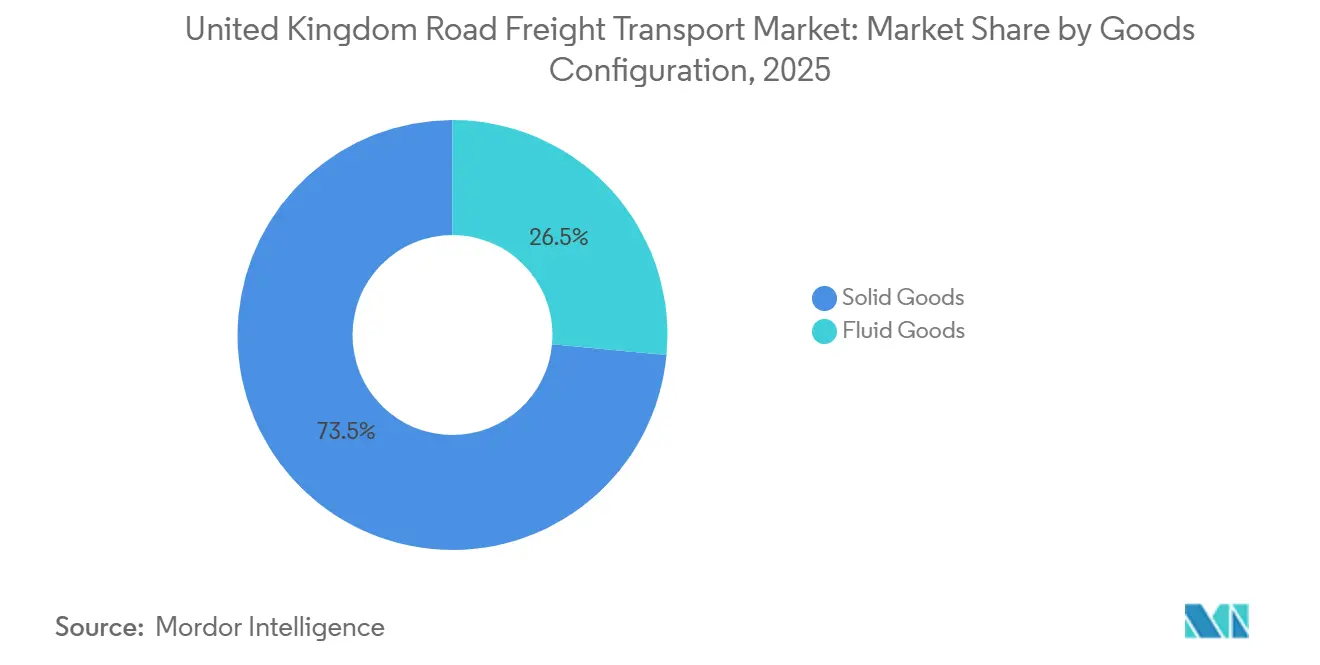
By goods configuration, solid goods retained 73.52% of the United Kingdom road freight transport market in 2025, while fluid goods are forecast to post the fastest 2.83% CAGR through 2031. Solid goods continue to dominate, covering a wide range of shipments from packaged consumer products to construction materials, with ongoing improvements in handling and transport efficiency supporting their strong volume base.
Fluid goods are gaining momentum, driven by demand for biofuel distribution and specialized pharmaceutical liquids that require insulated tanker transport. While additional cleaning and handling requirements extend turnaround times, higher service rates help maintain profitability. Advances in equipment such as walking-floor systems are also improving payload efficiency for bulk solids, reinforcing their continued importance in the market.
Note: Segment shares of all individual segments available upon report purchase
Get Detailed Market Forecasts at the Most Granular Levels
Download PDF
By Temperature Control: GDP Compliance Drives Premium Pricing
By temperature control, non-temperature retained 94.76% of the United Kingdom road freight transport market in 2025, while temperature-controlled is forecast to post the fastest 2.88% CAGR through 2031. Non-temperature freight continues to dominate due to its broad applicability across general cargo, retail, and construction segments, forming the backbone of everyday logistics operations.
Temperature-controlled transport is expanding rapidly, driven by demand from advanced pharmaceuticals such as cell and gene therapies. Specialized equipment and compliance standards enable premium pricing, encouraging investment in high-specification trailers. Innovations such as multi-zone vehicles and real-time monitoring systems are improving efficiency and reducing spoilage risks, raising operational standards and increasing barriers to entry within the market.
Geography Analysis
Domestic freight remains foundational, exchanging goods among London, the Midlands manufacturing spine, and northern consumption centers over a 200-mile radius. HS2 and Lower Thames Crossing guarantee aggregate and steel flows through 2030, anchoring consistent long-haul demand across M1, M6, and A1(M) arteries. The road-train trial amplifies efficiency on these trunks, adding 15% payload capacity per driver hour and reinforcing the road’s primacy over rail.
International traffic accelerates more quickly, buoyed by GVMS and BTOM that shrink paperwork and dwell, and by eight English Freeports that processed USD 10.9 billion of trade at 35% faster clearance in 2025. Dover-Calais lanes reclaim volumes lost to Brexit friction as digital processes mature. Northern Ireland’s dual-compliance surcharge of USD 163 per load tempers intra-UK island flows but is partially offset by predictable border transit under the Windsor Framework.
Capacity constraints lurk in cross-border parking deficits and cabotage limits that strip 22% of peak-season trucks. Nevertheless, certified low-carbon operators corner tender wins in London and the South East, where Scope-3 scrutiny is highest. Overall, geography continues to evolve from a domestic-centric baseline toward a balanced split, reshaping lane density and asset deployment within the United Kingdom road freight transport market[4]Savills Research, “UK Logistics Real Estate Market Report 2025,” savills.com .
Competitive Landscape
The United Kingdom road freight transport market is moderately fragmented. The top five players account for an estimated 34-38% of sector revenue, while hundreds of SMEs compete on spot subcontracting. DSV’s USD 15.4 billion takeover of DB Schenker in April 2025 created Europe’s largest logistics group and instantly expanded GDP-certified fleet reach into UK biotech hot-spots. Culina’s rollout of 85 electric reefers in March 2025 sets a sustainability benchmark and secures urban grocery contracts immune to Zero Emission charges.
Strategic acquisitions target niche capability rather than pure scale. GXO’s USD 230 million automated pharma sites integrate multi-temperature robotics, shortening pick-to-truck times and ensuring GDP audit readiness. Howard Tenens’ 45-unit fleet purchase focuses on HS2 bulk flows, revealing a horizontal move into construction logistics. The capacity to evidence carbon cuts and provide real-time data drives premium tender wins, marginalizing operators lacking telematics or Scope-3 audit trails.
Digital disruption advances via AI route optimization at Kinaxia, which slashed empty running from 27% to 16% in 2024. Autonomous convoy pilots on the M6 signal further cost compression potential, although regulatory approval remains years away. Warehousing scarcity in the Golden Triangle propels regional diversification to the East Midlands and Yorkshire, forcing carriers to redesign networks for longer last-mile legs yet benefiting those with nationwide depot footprints. Overall, competition now orbits around certification, data transparency, and asset specialization rather than raw fleet scale.
United Kingdom Road Freight Transport Industry Leaders
Culina Group
Turners (Soham) Ltd.
Wincanton PLC
DSV A/S (including DB Schenker)
DHL Group
- *Disclaimer: Major Players sorted in no particular order
Need More Details on Market Players and Competitors?
Download PDF
Recent Industry Developments
- March 2026: DHL Global Forwarding signed Memoranda of Understanding (MoUs) with Chinese firms JA Solar and Haier RRS at the DHL NOW & NEXT summit. These agreements cover multimodal logistics collaboration, warehousing, TMS integration, routing optimization and sustainability initiatives.
- March 2026: Maritime Transport began UK-wide deployment of electric heavy goods vehicles supported by significant investment in high-power charging infrastructure. This signals a major decarbonization push in UK road freight operations.
- February 2026: Maritime Transport officially opened its new Strategic Rail Freight Interchange at SEGRO Northampton Gateway, strengthening intermodal connectivity in the UK’s freight network.
- May 2025: Maersk announced updated UK inland tariff rates aimed at ensuring service sustainability and market capacity.
United Kingdom Road Freight Transport Market Report Scope
End User Industry
| Agriculture, Fishing, and Forestry |
| Construction |
| Manufacturing |
| Oil and Gas, Mining and Quarrying |
| Wholesale and Retail Trade |
| Others |
Destination
| Domestic |
| International |
Truckload Specification
| Full-Truck-Load (FTL) |
| Less than-Truck-Load (LTL) |
Containerization
| Containerized |
| Non-Containerized |
Distance
| Long Haul |
| Short Haul |
Goods Configuration
| Fluid Goods |
| Solid Goods |
Temperature Control
| Non-Temperature Controlled |
| Temperature Controlled |
| End User Industry | Agriculture, Fishing, and Forestry |
| Construction | |
| Manufacturing | |
| Oil and Gas, Mining and Quarrying | |
| Wholesale and Retail Trade | |
| Others | |
| Destination | Domestic |
| International | |
| Truckload Specification | Full-Truck-Load (FTL) |
| Less than-Truck-Load (LTL) | |
| Containerization | Containerized |
| Non-Containerized | |
| Distance | Long Haul |
| Short Haul | |
| Goods Configuration | Fluid Goods |
| Solid Goods | |
| Temperature Control | Non-Temperature Controlled |
| Temperature Controlled |
Need A Different Region or Segment?
Customize Now
Market Definition
- Agriculture, Fishing, and Forestry (AFF) - This end user industry segment captures the external (outsourced) logistics expenditure incurred by the AFF industry players on road freight transport service. The end user players considered are the establishments primarily engaged in growing crops, raising animals, harvesting timber, harvesting fish & other animals from their natural habitats and providing related support activities. Herein, across the value chain, Logistics Service Providers (LSPs) play a crucial role in acquisition, storage, handling, transportation, and distribution activities for the optimal & continuous flow of inputs (seeds, pesticides, fertilizers, equipment, and water) from manufacturers or suppliers to the producers and smooth flow of output (produce, agro-goods) to distributors/ consumers. This includes both termperature controlled and non-temperature controlled logistics, as and when required according to the shelf life of goods being transported or stored.
- Construction - This end user industry segment captures the external (outsourced) logistics expenditure incurred by the construction industry players, on road freight transport service. The end user players considered are the establishments primarily engaged in constructing, repairing and renovating residential & commercial buildings, infrastructure, engineering works, subdividing and developing land. Logistics Service Providers (LSPs) play a crucial role in increasing profitability of construction projects by maintaing the inventory of raw materials & equipment, time-critical supplies and by providing other value added services for effective project management.
- Containerized Road Freight Transport - The segment captures the external (outsourced) logistics expenditure incurred by the road freight transport service end users on Full-Truck-Load (FTL) services. FTL road freight transport is characterized as a full single load not combined with other shipments. It comprises of shipments (i) devoted to the goods of a single shipper (ii) taken directly from a point of origin to one or more destination points (iii) comprising of bulk mail truck transportation (iv) comprising of both Container (Full Container Load, FCL)/Non-Container trucking services (v)comprsing of goods requiring temperature controlled or non-temperature controlled transportation services (vi) comprising of bulk liquid tankering (vii) invoving trucking of waste (viii) hazardous material trucking. Related value added services (VAS) of sorting, consolidation, deconslidation are included in the other services segment of freight and logistics market.
- Export Trends and Import Trends - Overall logistics performance of an economy is positively and significantly (statistically) correlated to its trade performance (exports and imports). Hence, in this industry trend, total value of trade, major commodities/ commodity groups and the major trade partners, for the studied geography (country or region as per the scope of report) have been analysed alongside the impact of major trade/logistics infrastructure investments & regulatory environment.
- Fluid Goods - The segment captures the external (outsourced) logistics expenditure incurred by the road freight transport service end users for the transport of bulk liquids, that are often used in extraction, manufacturing, food processing, agriculture industries among others. It includes transportation of liquids like (i) Chemicals/ hazardous goods (for instance acids) (ii) Water (potable as well as waste) (iii) Oil and gas (upstream as well as downstream like gasoline, fuel, crude oil, or propane), (iv) Food grade bulk liquids (like milk, or juice), (v) Rubber, (vi) Agrichemical products, among others. These goods are generally transported through tanker trucking.
- Fuel Price - Fuel price spikes can cause delays and diruption for logistics service providers (LSPs), while drops in the same can result in higher short-term profitability and increased market rivalry to offer consumers with the best deals. Hence, the fuel price variations have been studied over the review period and presented along with the causes as well as market impacts.
- Full-Truck-Load (FTL) Road Freight Transport - The segment captures the external (outsourced) logistics expenditure incurred by the road freight transport service end users on Full-Truck-Load (FTL) services. FTL road freight transport is characterized as a full single load not combined with other shipments. It comprises of shipments (i) devoted to the goods of a single shipper (ii) taken directly from a point of origin to one or more destination points (iii) comprising of bulk mail truck transportation (iv) comprising of both Container (Full Container Load, FCL)/Non-Container trucking services (v)comprsing of goods requiring temperature controlled or non-temperature controlled transportation services (vi) comprising of bulk liquid tankering (vii) invoving trucking of waste (viii) hazardous material trucking. Related value added services (VAS) of sorting, consolidation, deconslidation are included in the other services segment of freight and logistics market.
- GDP Distribution by Economic Activity - Nominal Gross Domestic Product and distribution of the same, across major economic sectors in the geography studied (country or region as per scope of the report) have been studied and presented in this industry trend. As GDP is positively related to the profitability and growth of logistics industry, this data has been used in adjunction to the input-output tables/ supply-use tables for analyzing the potential major contributing sectors towards the logistics demand.
- GDP Growth by Economic Activity - Growth of Nominal Gross Domestic Product across major economic sectors, for the geography studied (country or region as per scope of the report) have been presented in this industry trend. This data has been utilized for assessing the growth of logistics demand from all the market end users (economic sectors considered here).
- Inflation - Variations in both Wholesale Price Inflation (YoY change in producer price index) and Consumer Price Inflation have been presented in this industry trend. This data has been used to assess the inflationary environment as it plays a vital role in smooth functioning of the supply chain, directly impacting the logistics operational cost components e.g., pricing of tyres, driver wages & benefits, energy/fuel prices, maintenace costs, toll charges, warehousing rents, custom brokerage, forwarding rates, courier rates etc. hence impacting the overall freight and logistics market.
- Key Industry Trends - The report section named "Key Industry Trends" include all the key variables/parameters studied to better analyze the market size estimates and forecasts. All the trends have been presented in the form of data points (time series or latest available data points) along with analysis of the paramter in the form of concise market relevant commentary, for the geography studied (country or region as per the scope of report).
- Key Strategic Moves - The action taken by a company to differentiate from its competitor or used as a general strategy is referred to as a key strategic move (KSM). This includes (1) Agreements (2) Expansions (3) Financial Restructuring (4) Mergers and Acquisitions (5) Partnerships, and (6) Product Innovations. Key players (Logistics Service Providers, LSPs) in the market have been shortlisted, their KSM have been studied and presented in this section.
- Less than-Truck-Load (LTL) Road Freight Transport - The segment captures the external (outsourced) logistics expenditure incurred by the road freight transport service end users on Less than-Truck-Load (LTL) services. LTL road freight transport is characterized as multiple shipments combined onto a single truck for multiple deliveries within a network. It comprises of establishments (i) primarily engaged in general and specialized freight trucking of less than complete truck-loads, (ii) characterized by the use of terminals to consolidate shipments, generally from several shippers, into a single truck for haulage between a load assembly terminal and a disassembly terminal, where the load is sorted and shipments are re-routed for delivery (iv) Less than-Container-Load (LCL) shipping/ Groupage Shipping in case of trucking services. The activities in scope include (i) local pick-up, (ii) line-haul, and (iii) local delivery. Related value added services (VAS) of sorting, consolidation, deconslidation are included in the other services segment of freight and logistics market.
- Logistics Performance - Logistics Performance and Logistics Costs are the backbone of trade, and influences trade costs, making countries compete globally. Logistics performance is influenced by market wide adopted supply chain management strategies, government services, investments & policies, fuel/ energy costs, inflationary environment etc. Hence, in this industry trend, the logistics performance of the geography studied (country/ region as per the scope of report) has been analysed and presented over the review period.
- Major Truck Suppliers - Market share of truck brands is influenced by factors like geographical preferences, portfolio of truck types, truck prices, local production, truck repair & maintenance service peneteration, customer support, technological innovations (like electric vehicles, digitalization, autonomous trucks), fuel efficiency, financing options, annual maintenance costs, availability of substitutes, marketing startegies etc. Hence, the distribution (share % for base year of the study) of truck sales volume for leading truck brands and commentary on current market scenario & market anticipation over the forecast period have been presented in this industry trend.
- Manufacturing - This end user industry segment captures the external (outsourced) logistics expenditure incurred by the Manufacturing industry players, on road freight transport service. The end user players considered are the establishments primarily engaged in the chemical, mechanical or physical transformation of materials or substances into new products. Logistics Service Providers (LSPs) play a crucial role in maintaining a smooth flow of raw materials across the supply chain, enabling timely delivery of finished goods to distributors or end customers and storing & supplying the raw materials to clients for just-in-time manufacturing.
- Modal Share - Freight Modal Share is influenced by factors like modal productivity, government regulations, containerization, distance of shipment, temperature control requirements, type of goods, international trade, terrain, speed of delivery, shipment weight, bulk shipments, etc. Also, modal share by tonnage (tons) and modal share by freight turnover (ton-km) differ as per average distance of shipments, weight of major commodity groups transported in the economy and number of trips. This industry trend represents the distribution of freight transported by mode of transport (tons as well as ton-km), for the study base year.
- Oil and Gas, Mining and Quarrying - This end user industry segment captures the external (outsourced) logistics expenditure incurred by the extraction industry players, on road freight transport service. The end user players considered are the establishments that extract naturally occurring mineral solids, such as coal and ores; liquid minerals, such as crude petroleum; and gases, such as natural gas. Logistics Service Providers (LSPs) covers entire phases from upstream to downstream and plays a crucial role in the transportation of machinery, drilling equipments, extracted minerals, crude oil & natural gas and refined/ processed products from one place to another.
- Other End Users - Other end user segment captures the external (outsourced) logistics expenditure incurred by the financial services (BFSI), real estate, educational services, healthcare, and professional services (administrative, waste management, legal, architectural, engineering, design, consulting, scientific R&D), on road freight transport service. Logistics Service Providers (LSPs) plays a crucial role in the reliable movement of supplies and documents to/from these industries such as transporting any equipment or resources required, shipping confidential documents and files, movement of medical goods & supplies (surgical supplies and instruments, including gloves, masks, syringes, equipment) to name a few.
- Producer Price Inflation - It indicates inflation from viewpoint of the producers viz. the average selling price received for their output over a period of time. Annual change (YoY) of producer price index is reported as wholesale price inflation in the "Inflation" industry trend. As WPI captures dynamic price movements in most comprehensive way, it is widely used by governments, banks, industry, business circles and is deemed important in formulation of trade, fiscal and other economic policies. The data has been used in adjunction to consumer price inflation for better understanding the inflationary environment.
- Road Freight Pricing Trends - Freight pricing by mode of transport (USD/tonkm), over the review period, has been presented in this industry trend. The data has been used in assessing the inflationary environment, impact on trade, freight turnover (tonkm), road freight transport market demand and hence the road freight transport market size.
- Road Freight Tonnage Trends - Freight tonnage (weight of goods in tons) handled by mode of transport, over the review period, has been presented in this industry trend. The data has been used as one of the parameters apart from average distance per shipment (km), freight volume (tonkm), and freight pricing (USD/tonkm) to assess the freight transport market size.
- Road Freight Transport - Hiring a road freight transport logistics service provider (LSP) or haulier (outsourced logistics), for the transport of commodities constitutes road freight transport market. The scope of study includes (i) road transport of goods reported by hauliers registered in the reporting countries (ii) transport of raw materials or manufactured goods (solids as well as fluids) (iii) transport using commerical motor vehicles (rigid trucks or tractor-trailers, (iv) Full-Truck-Load (FTL) or Less than-Truck-Load (LTL) transport (v) containerized or non-containerized transport (vi) temperature controlled or non-temperature controlled trasnport, (vii) short haul or long haul (Over-the-road, OTR) transport, (viii) used office or household goods transport (movers and packers), (ix) other specialized cargo transport (dangerous goods, oversized cargo) and (x) outsourced first mile/ middle mile/last mile delivery shipments undertaken by road freight transport players. The scope does not include (i) transport undertaken by hauliers registered in other countries (ii) last mile meal delivery market (iii) grocery delivery market (iv) transportation via road network undertaken/ reported by Courier, Express, and Parcel (CEP) players.
- Road Length - As infrastructure plays a vital role in an economy's logistics performance, variables like length of roads, distribution of road length by surface category (paved v/s unpaved), distribution of road length by road classification (expressways v/s highways v/s other roads), have been analysed and presented in this industry trend.
- Segmental Revenue - Segmental Revenue has been triangulated or computed and presented for all the major players in the market. It refers to the road freight transport market specific revenue earned by the company, over the base year of study, in the geography studied (country or region as per the scope of report). It is computed through the study and analysis of major parameters like financials, service portfolio, employee strength, fleet size, investments, number of countries present in, major economies of concern, etc. that have been reported by the company in its annual reports, webpage. For companies having scarce financial disclosures, paid databases like D&B Hoovers, Dow Jones Factiva have been resorted to and verified through industry/expert interactions.
- Short Haul Road Freight Transport - The segment captures the external (outsourced) logistics expenditure incurred by the road freight transport service end users on local trucking (less than 100 miles). It includes the road transport of goods (i) within a single administrative area and its hinterland, (ii) by smaller trucks and pickup trucks (iii) via containerized as well as dry bulk services (iv) intermodal from ports, container terminals or airports, and (v) outsourced first mile/ last mile delivery shipments undertaken by road freight transport players.
- Transport and Storage Sector GDP - Value and growth of Transport and Storage Sector GDP has a direct relation to the freight and logistics market size, and hence road freight transport market size. Therefore, this variable has been studied and presented over the review period, in value terms (USD) and as share % of total GDP, in this industry trend. The data has been supported by concise and relevant commentary around the investments, developments, and current market scenario.
- Trends in E-Commerce Industry - Enhanced internet connectivity and boom in smartphone penetration, coupled with increasing disposable incomes, has led to a phenomenal growth in the e-commerce market globally. Online shoppers require fast and efficient delivery of their orders leading to an increase in the demand for logistics services especially e-commerce fulfilment services. Hence, the Gross Merchandise Value (GMV), historial and projected growth, breakup of major commodity groups in e-commerce industry for the studied geography (country or region as per scope of the report) have been analysed and presented in this industry trend.
- Trends in Manufacturing Industry - Manufacturing industry involves the transformation of raw materials into finished products, while logistics industry ensures the efficient flow of raw materials to the factory, and the transport of manufactured products to the distributors & consumers. Demand-Supply of both industries are highly cross-linked and critical for a seamless supply chain. Hence, the Gross Value Added (GVA), breakup of GVA into major manufacturing sectors, and growth of manufacturing industry over the review period have been analysed and presented, in this industry trend.
- Trucking Fleet Size By Type - Market share of truck types is influenced by factors like geographical preferences, major end user industries, truck prices, local production, truck repair & maintenance service peneteration, customer support, technological disruptions (like electric vehicles, digitalization, autonomous trucks) etc. Hence, the distribution (share % for base year of study) of truck parc volume by type of truck, market disruptors, truck manufacturing investments, truck specifications, truck use & import regulations, and market anticipation over the forecast period have been presented in this industry trend.
- Trucking Operational Costs - The prime reasons for measuring/ benchmarking logistics performance of any trucking company are to reduce operational costs and increase profitability. On the other hand, measuring operational costs helps to identify whether and where to make operational changes to control expenses and identify areas for improved performance. Hence, in this industry trend, trucking operational costs and the variables involved viz. driver wages & benefits, fuel prices, repairs & maintenance costs, tyre costs etc. have been studied over the base year of study, and presented for the geography studied (country or region as per the scope of report).
- Wholesale and Retail Trade - This end user industry segment captures the external (outsourced) logistics expenditure incurred by the wholesalers and retailers, on road freight transport service. The end user players considered are the establishments primarily engaged in wholesaling or retailing merchandise, generally without transformation, and rendering services incidental to the sale of merchandise. Logistics Service Providers (LSPs) plays a crucial role in the reliable movement of supplies to and finished products from production houses to the distributors and finally to the end customer covering activites like material sourcing, transportation, order fulfillment, warehousing & storage, demand forecasting, inventory management etc.
| Keyword | Definition |
|---|---|
| Cabotage | Road transport by a motor vehicle registered in a country performed on the national territory of another country. |
| Cross Docking | Cross docking is a logistics procedure where products from a supplier or manufacturing plant are distributed directly to a customer or retail chain with marginal to no handling or storage time. Cross docking takes place in a distribution docking terminal; usually consisting of trucks and dock doors on two (inbound and outbound) sides with minimal storage space. The name ‘cross docking’ explains the process of receiving products through an inbound dock and then transferring them across the dock to the outbound transportation dock. |
| Cross Trade | International road transport between two different countries performed by a road motor vehicle registered in a third country. A third country is a country other than the country of loading/embarkation and than the country of unloading/disembarkation. |
| Dangerous Goods | The classes of dangerous goods carried by Road are those defined by the fifteenth revised edition of the UN Recommendations on the Transport of Dangerous Goods, United Nations, Geneva 2007. They include Class 1: Explosives; Class 2: Gases; Class 3: Flammable Liquids; Class 4: Flammable solids- substances liable to spontaneous combustion; substances which, on contact with water, emit flammable gases; Class 5: Oxidizing substances and organic peroxides; Class 6: Toxic and infectious substances; Class 7: Radioactive material and Class 8: Corrosive substances, Class 9: Miscellaneous dangerous substances and articles. |
| Direct Shipment | Direct shipment is a method of delivering goods from the supplier or the product owner to the customer directly. In most cases, the customer orders the goods from the product owner. This delivery scheme reduces transportation and storage costs, but requires additional planning and administration. |
| Drayage | A drayage is a form of trucking service that connects the different modes of shipping (intermodal), such as ocean freight or air freight. It’s a short-haul trip that transports goods from one place to another, usually before or after its long-haul shipping process. Drayage trucks move cargo to and from various destinations, such as container ships, storage lots, order fulfillment warehouses, and rail yards. Typically, drayage only transports goods in short distances and operates only in one metropolitan area. It also requires only one trucker in a single shift. But despite this, but it plays an important role in long-haul shipping because it gets the goods to the cargo and vice versa. It makes intermodal transport much more efficient and enables the seamless transfer of goods to the end customer. |
| Dry van | A dry van is a type of semi-trailer that's fully enclosed to protect shipments from outside elements. Designed to carry palletized, boxed or loose freight, dry vans aren't temperature-controlled (unlike refrigerated “reefer” units) and can't carry oversized shipments (unlike flatbed trailers). |
| Final Demand | Final demand includes all types of commodities (goods as well as services) consumed as final use and might include personal consumption, or consumption by government, by businesses as capital investment, and as exports. includes all types of commodities (goods as well as services) consumed as final use and might include personal consumption, or consumption by government, by businesses as capital investment, and as exports. |
| Flatbed Truck | A flatbed truck is a type of truck with rigid design. It has a back body that is flatly shaped for easy loading and unloading of goods. The flatbed truck is mostly used to transport heavy, oversized, wide and indelicate goods such as machinery, building supplies or equipment. Due to the truck open body, the goods transported with it must not be vulnerable to rain. By functionality, the flatbed truck is comparable to a flatbed trailer. |
| Inbound Logistics | Inbound logistics is the way materials and other goods are brought into a company. This process includes the steps to order, receive, store, transport and manage incoming supplies. Inbound logistics focuses on the supply part of the supply-demand equation. |
| Intermediate Demand | Intermediate demand includes goods, services, and maintenance and repair construction sold to businesses, excluding capital investment. |
| International Loaded | Place of loading of goods in reporting country (i.e., country in which the vehicle performing the transport is registered) and place of unloading in a different country. |
| International Unloaded | Place of unloading of goods in reporting country (i.e., country in which the vehicle performing the transport is registered) and place of loading in a different country. |
| OOG cargo | Out of Gauge (OOG) cargo is any cargo that can not be loaded into six-sided shipping containers simply because it is too large. The term is a very loose classification of all cargo with dimensions beyond the maximum 40HC container dimensions. That is a length beyond 12.05 meters – a width beyond 2.33 meters – or a height beyond 2.59 meters. |
| Pallets | Raised platform, intended to facilitate the lifting and stacking of goods. |
| Part load | A part load describes goods which only fills a truck partially. In essence, the quantity of the shipment is bigger than the Less Than Truckload (LTL) shipment. Also, the shipment cannot fully occupy a truck i.e. its capacity is much lower than a Full Truckload (FTL) shipment. |
| Paved Road | Road surfaced with crushed stone (macadam) with hydrocarbon binder or bituminized agents, with concrete or with cobblestone. |
| Reverse Logistics | Reverse logistics comprises of the sector of supply chains that process anything returning inwards through the supply chain or traveling ‘backward’ through the supply chain. |
| Road Freight Transport Service | Hiring a trucking agency for transport of commodities (raw materials or manufactured goods including both solids and liquids) form the origin to a destination within the country (domestic) or cross-border (international) constitutes road freight transport market. The service might be Full-Truck-Load or Less than-Truck-Load, containerized or non-containerized, temperature controlled or non temperature controlled, short haul or long haul. |
| Tautliner vehicle | Tautliner and curtainsider are used as generic names for curtain sided trucks/trailers. The curtains are permanently fixed to a runner at the top and detachable rails/poles at front and rear, allowing the curtains to be drawn open and forklifts used all along the sides for easy and efficient loading and unloading. When closed for travel, vertical load restraint straps are attached to a rope rail beneath the truck bed, connecting the truck bed and curtain along both sides. Winches at either end of the curtain tension it, hence the 'Tautliner' name. This stops the curtain from flapping or drumming in the wind and can also help retain light loads from slipping sideways. |
| Transport for hire or reward | The carriage for remuneration of goods. |
| Unpaved Road | Road with a stabilized base not surfaced with crushed stone, hydrocarbon binder or bituminized agents, concrete or cobblestone. |
Need More Details on Market Definition?
Ask a Question
Research Methodology
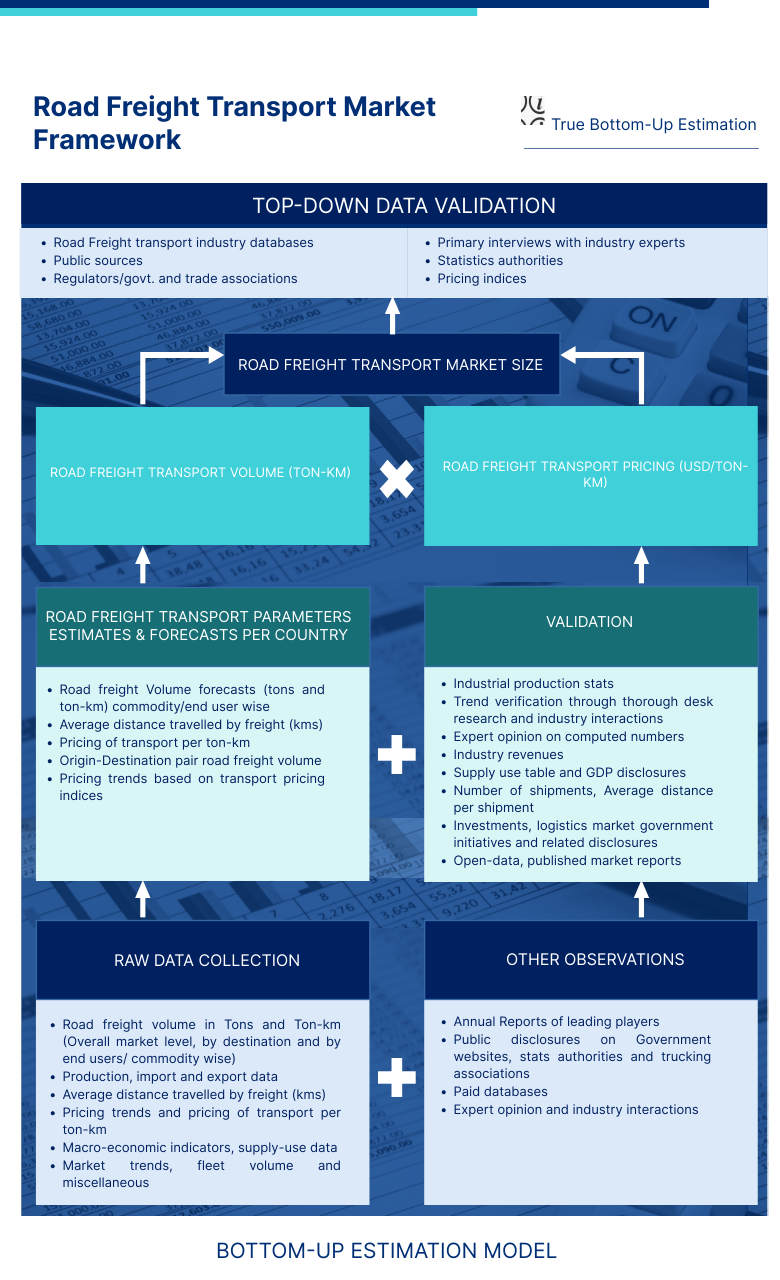
Mordor Intelligence follows a four-step methodology in all our reports.
- Step-1: Identify Key Variables: In order to build a robust forecasting methodology, the variables and factors identified in Step-1 are tested against available historical market numbers. Through an iterative process, the variables required for market forecast are set and the model is built on the basis of these variables.
- Step-2: Build a Market Model: Market-size estimations for the forecast years are in nominal terms. Inflation is considered to be a part of the pricing, and the average selling price (ASP) is varying throughout the forecast period for each country
- Step-3: Validate and Finalize: In this important step, all market numbers, variables and analyst calls are validated through an extensive network of primary research experts from the market studied. The respondents are selected across levels and functions to generate a holistic picture of the market studied.
- Step-4: Research Outputs: Syndicated Reports, Custom Consulting Assignments, Databases & Subscription Platforms
Get More Details On Research Methodology
Download PDF




