
Market Overview
| Study Period | 2021 - 2031 |
|---|---|
| Forecast Data Period | 2026 - 2031 |
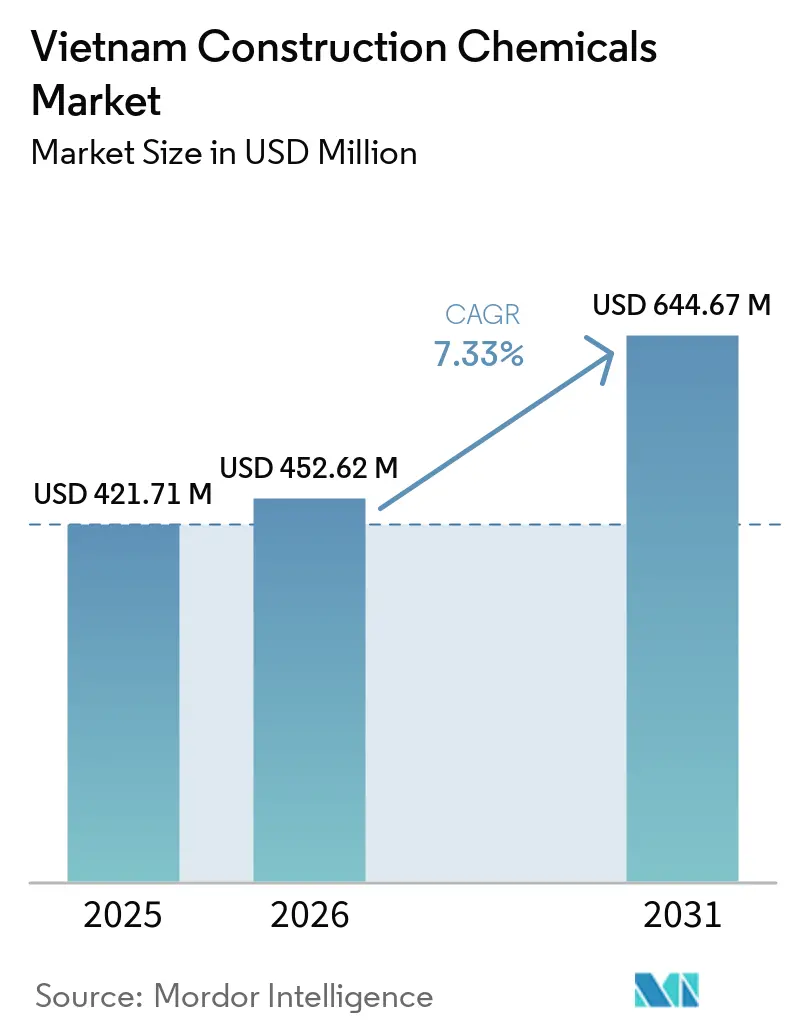
| Base Year Market Size (2025) | USD 421.71 Million |
| Market Size (2026) | USD 452.62 Million |
| Market Size (2031) | USD 644.67 Million |
| Growth Rate (2026 - 2031) | 7.33% CAGR |
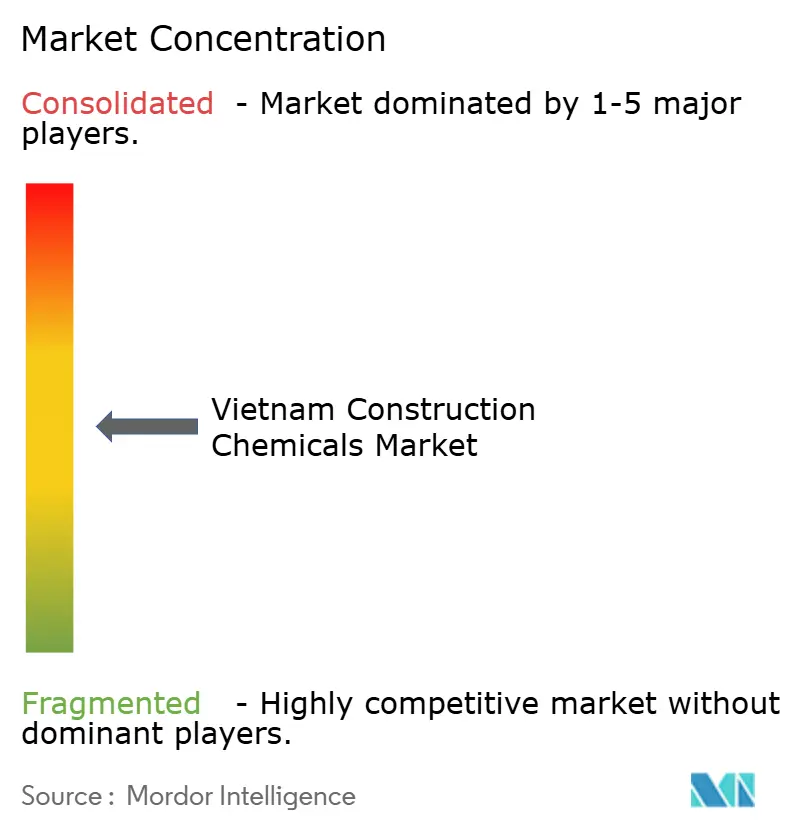
| Market Concentration | Medium |
Major Players *Disclaimer: Major Players sorted in no particular order Image © Mordor Intelligence. Reuse requires attribution under CC BY 4.0. | |
Vietnam Construction Chemicals Market Analysis by Mordor Intelligence
The Vietnam Construction Chemicals Market size is expected to increase from USD 421.71 million in 2025 to USD 452.62 million in 2026 and reach USD 644.67 million by 2031, growing at a CAGR of 7.33% over 2026-2031. Robust government capital spending, a wave of foreign-invested industrial parks, and a nationwide push for green-certified buildings are reshaping product specifications, driving demand for high-performance admixtures, waterproofing membranes, and low-VOC coatings. Public investment reached VND 791 trillion (approximately USD 67 billion) in 2025, focusing on expressways, airports, and metro systems that require chloride-resistant mortars, superplasticizers, and crack-bridging elastomeric membranes. Concurrently, Vietnam’s plan to develop 221 new industrial parks by 2030 and the USD 21.68 billion in realized foreign direct investment recorded in 2024 are sustaining demand for flooring resins, sealers, and surface treatments in regions such as Bac Ninh, Binh Duong, and Dong Nai. Developers aiming for LOTUS (Leadership in Organizing, Training, Using, and Sustaining), Leadership in Energy and Environmental Design (LEED), and Excellence in Design for Greater Efficiencies (EDGE) certifications increasingly specify products with Environmental Product Declarations, favoring premium brands with traceable supply chains. Additionally, the Ministry of Construction’s Circular 10/2024/TT-BXD enforces stricter quality standards, discouraging informal suppliers.
Key Report Takeaways
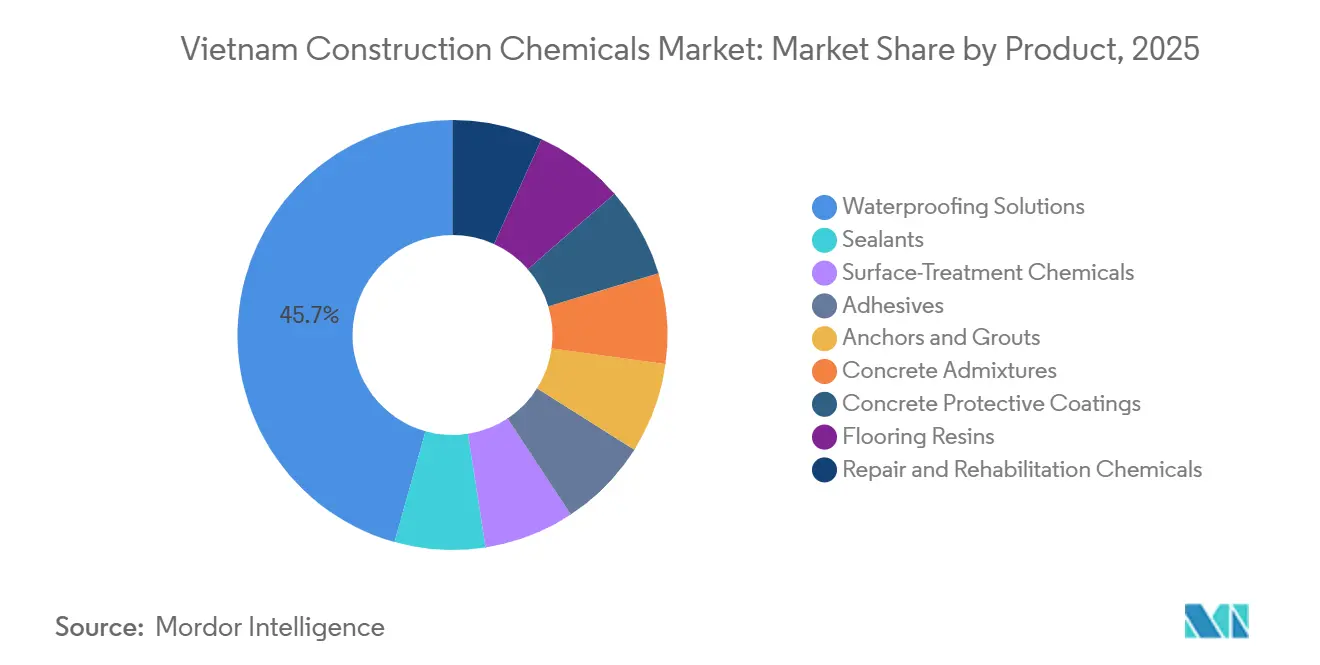
- By product, waterproofing solutions led with 45.66% of the Vietnam construction chemicals market share in 2025, while concrete admixtures posted the fastest growth at an 8.19% CAGR through 2031.
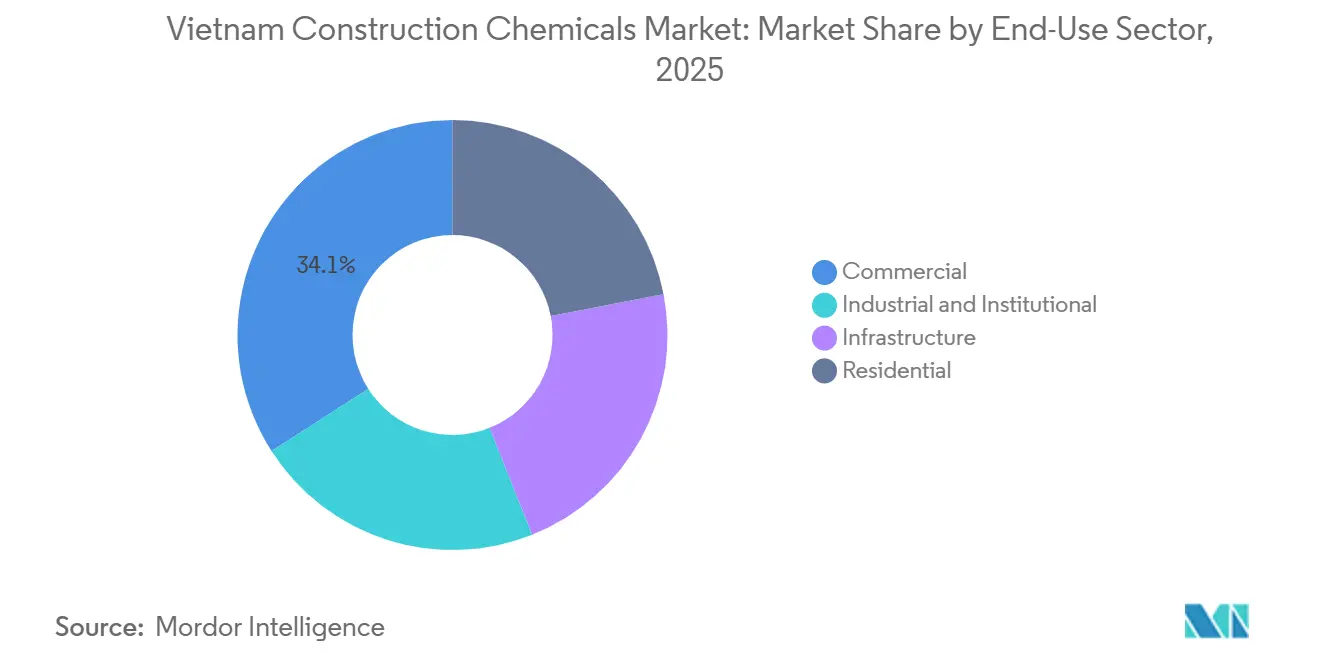
- By end-use sector, the commercial segment held 34.07% of the Vietnam construction chemicals market share in 2025 and is advancing at a 7.47% CAGR through 2031.
Note: Market size and forecast figures in this report are generated using Mordor Intelligence’s proprietary estimation framework, updated with the latest available data and insights as of 2026.
Vietnam Construction Chemicals Market Trends and Insights
Drivers Impact Analysis*
| Driver | (~) % Impact on CAGR Forecast | Geographic Relevance | Impact Timeline |
|---|---|---|---|
| Mega-infrastructure pipeline boosts specialty-admixture demand | +2.1% | National, with concentration in Hanoi, Ho Chi Minh City, Da Nang corridors | Medium term (2-4 years) |
| Transition from on-site mixed to ready-mixed concrete | +1.8% | National, led by urban centers and industrial zones | Short term (≤ 2 years) |
| Rapid penetration of green-label certified products | +1.3% | National, early adoption in Hanoi and Ho Chi Minh City commercial projects | Medium term (2-4 years) |
| Growth of renovation and reconstruction projects | +0.9% | National, with urban upgrading focus in Ho Chi Minh City and Hanoi | Long term (≥ 4 years) |
| Digitalized job-site dosing and QA systems lift premium uptake | +0.7% | National, industrial parks and large commercial sites | Short term (≤ 2 years) |
| Source: Mordor Intelligence | |||
Understand The Key Trends Shaping This Market
Download PDF
Mega-Infrastructure Pipeline Boosts Specialty-Admixture Demand
Expressways, bridges, and airport projects such as CT.33, Dai Ngai Bridge, and Long Thanh International Airport require chloride-resistant mortars and third-generation polycarboxylate ether superplasticizers that maintain workability at ambient temperatures above 35 °C. The Eastern North-South Expressway Phase 2 alone is estimated to require 200,000 tonnes of admixtures, repair mortars, and surface treatments over five construction seasons[1].MC-Bauchemie Vietnam, “MC-PowerFlow for North-South Expressway,” mc-bauchemie.vn Contractors pre-qualify branded systems such as SikaPlast-396 VN and BestFlow A325 to achieve water-cement ratios below 0.35 and 28-day compressive strengths exceeding 60 MPa. Suppliers embedding technical service teams in site laboratories secure recurring volume orders across multiyear project phases, ensuring specification compliance throughout the design-build-operate cycle.
Transition from On-Site Mixed to Ready-Mixed Concrete
Urban ordinances restricting on-site batching to reduce dust and traffic congestion are accelerating the shift toward ISO 9001-certified ready-mixed concrete (RMC) plants. RMC logistics drive demand for retarders and viscosity modifiers that extend slump life over delivery distances of up to 30 km in peri-urban areas such as Binh Duong. Digital dosing platforms, which measure admixtures with ±0.1% precision, have reduced material waste by 20% and compressive-strength variability by up to 25%, reinforcing the preference for premium admixtures with precise formulation tolerances.
Rapid Penetration of Green-Label Certified Products
LOTUS V4, LEED, and EDGE frameworks now allocate up to 6% of project points for low-volatile organic compound (VOC) sealants, carbon-neutral curing compounds, and Environmental Product Declaration (EPD)-certified membranes. High-profile projects such as Westlake Square in Hanoi mandate the use of products like SikaProof-110 membranes and Sikagard-7000 CR coatings, which carry third-party eco-labels. In 2025, Saint-Gobain’s Quảng Trị DURAflex plant became Vietnam’s first zero-carbon fiber-cement facility, utilizing biomass boilers and 100% renewable electricity. This shift influences construction chemical specifications in the company’s downstream board and façade systems.
Growth of Renovation and Reconstruction Projects
World Bank funding of USD 500 million for canal renovation and urban flood-control upgrades in Ho Chi Minh City is driving demand for carbon-fiber laminates, epoxy injection resins, and corrosion inhibitors. Projects like the Thu Thiem 4 Bridge employ fiber-wrapping and injection grouting techniques to extend service life by 30 years. Meanwhile, heritage restoration projects along the Red River Boulevard utilize breathable renders that comply with Vietnamese National Standard (TCVN) 10304:2025 durability standards.
Restraints Impact Analysis*
| Restraint | (~) % Impact on CAGR Forecast | Geographic Relevance | Impact Timeline |
|---|---|---|---|
| Volatility in petrochemical-based resin prices | -1.2% | National, with acute impact on waterproofing and coating manufacturers | Short term (≤ 2 years) |
| Fragmented applicator ecosystem limits spec-compliance | -0.8% | National, particularly in residential and small commercial segments | Medium term (2-4 years) |
| Counterfeit waterproofing products erode brand trust | -0.5% | National, concentrated in retail and small-project channels | Long term (≥ 4 years) |
| Source: Mordor Intelligence | |||
Volatility in Petrochemical-Based Resin Prices
In 2024, prices for PVC, epoxy, and polyurethane feedstocks surged by 15-20% within three months, impacting manufacturers reliant on imported resins and unable to hedge long-term contracts. Smaller producers with annual outputs below 5,000 tonnes faced challenges, including price increases and delayed product launches. In contrast, larger companies diversified into bio-based inputs and recycled polyols to reduce dependency on crude oil prices. For example, Saint-Gobain’s biomass-powered DURAflex line reduces Scope 1 CO₂ emissions by 2,000 tonnes annually, demonstrating how localized feedstocks can mitigate price volatility.
Fragmented Applicator Ecosystem Limits Spec-Compliance
Approximately 60-70% of small contractors procure materials through informal channels and apply them without manufacturer training, leading to issues such as under-dosage of superplasticizers or incorrect mixing ratios in two-component epoxies. Although the AMPP-certified industrial coating program launched by VIVABLAST in 2024 addresses this skills gap, it currently reaches only a small fraction of the estimated 250,000 construction applicators nationwide.
*Our updated forecasts treat driver/restraint impacts as directional, not additive. The revised impact forecasts reflect baseline growth, mix effects, and variable interactions.
Segment Analysis
By Product: Waterproofing Dominance Meets Admixture Momentum
Waterproofing solutions accounted for 45.66% of the Vietnam construction chemicals market share in 2025, driven by Ho Chi Minh City regulations requiring high-elasticity membranes for basements situated below 3 meters sea level. This category includes crystalline admixtures, penetrating sealers, and membrane rolls, with membranes holding higher value due to their use in metro tunnels, wastewater plants, and deep-podium car parks that need multi-layer, crack-bridging systems. Bestmix delivered 100,000 tonnes of BestSeal membranes to 75 mega factories in 2024, reflecting the high-volume demand in the Vietnam construction chemicals market.
Concrete admixtures is the fastest-growing segment, with an 8.19% CAGR projected through 2031, steadily increasing its share in the Vietnam construction chemicals market. Ready-mixed concrete plants pre-dose polycarboxylate ether superplasticizers like SikaPlast-396 VN and MC-PowerFlow 2116 to achieve 28-day strengths exceeding 60 MPa, even under 35 °C coastal humidity. The demand for admixtures is also rising due to high-speed railway viaducts and 40-story composite towers that require slump-retaining retarders and rheology-modifying agents to pump concrete above 200 meters.
Adhesives, anchors and grouts, sealants, protective coatings, flooring resins, and repair chemicals cater to high-value niches such as seismic anchorage and (Good Manufacturing Practice)-compliant flooring. Epoxy anchors certified to TCVN 10304:2025 are used for wind-turbine foundations and port crane rails, while electrostatic-discharge-safe floor toppings dominate electronics clean rooms in Bac Ninh. Carbon-fiber laminates and injection epoxies are now standard for bridge rehabilitation projects.
Note: Segment shares of all individual segments available upon report purchase
Get Detailed Market Forecasts at the Most Granular Levels
Download PDF
By End-Use Sector: Commercial Leads the Market Growth
The commercial segment accounted for 34.07% of the Vietnam construction chemicals market size in 2025 and is projected to grow at a 7.47% CAGR through 2031. Mixed-use towers, such as the USD 156 million Capital One twin towers in Hanoi, are targeting LEED Gold certification by using low-VOC sealants and carbon-neutral curing compounds. Similarly, AEON MALL Thanh Hoa and Westlake Square require EPD-verified membranes and Electrostatic Discharge (ESD)-safe floor systems, driving demand for premium products across retail and office developments.
Infrastructure projects consume significant volumes of admixtures, coatings, and grouts due to their concrete-intensive nature. For instance, the Eastern North-South Expressway allocated USD 30 million for construction chemicals over an 88 km stretch, while Long Thanh Airport and the North-South high-speed rail are expected to require 200,000 tonnes of admixtures and repair mortars by 2030. Residential social housing initiatives are anticipated to increase demand for base-grade products while adhering to updated durability codes. Industrial and institutional developments, such as Vietnam Singapore Industrial Parks, consume 15,000–20,000 tonnes of admixtures, sealers, and toppings per phase, further driving market growth.
Note: Segment shares of all individual segments available upon report purchase
Get Detailed Market Forecasts at the Most Granular Levels
Download PDF
Geography Analysis
Ho Chi Minh City, Hanoi, and Da Nang remain the key drivers of the Vietnam construction chemicals market. Ho Chi Minh City’s VND 500 million World Bank-financed flood-control upgrade has directed demand toward silane-siloxane repellents and nano-silica sealers, which reduce water ingress by 80% in saline soils. The city’s basement membrane regulations further emphasize the need for certified elastomeric sheets and crystalline coatings.
Hanoi is home to major projects such as the USD 156 million Capital One twin towers and the VND 855,000 billion Red River Boulevard, both of which require digital batch tracking and low-VOC materials, encouraging contractors to opt for premium brands. Da Nang’s tourism-driven growth saw the opening of TTC Plaza in early 2026, which utilized MAPEI DYNAMON SR2 VN for pumped concrete and solvent-free epoxies for retail floors.
Industrial clusters are reshaping spatial demand. Bac Ninh added nine industrial parks in 2024, bringing the total to 33 parks spanning 10,100 hectares, with significant consumption of ESD-safe flooring and moisture-tolerant sealers. Binh Duong, Dong Nai, and Hai Phong are following similar trends. A 333-hectare Vietnam Singapore Industrial Park in Thai Binh, launched in 2024, is expected to consume 20,000 tonnes of admixtures and toppings during its initial phase. Central provinces align with infrastructure projects like the CT.33 coastal road and Dai Ngai Bridge, which require chloride-resistant mortars due to saline exposure. The Mekong Delta enforces new TCVN 10304:2025 pile design rules for geotechnical verification, increasing demand for anchoring grouts and anti-washout admixtures in soft-soil foundations[2]Ministry of Science and Technology, “TCVN 10304:2025 Pile Foundations,” tcvn.gov.vn.
Competitive Landscape
The Vietnam construction chemicals market shows moderate concentration, with the top five players including MAPEI S.p.A., Bestmix Corporation, MC-Bauchemie, Saint-Gobain, and Sika AG. Multinational companies such as Sika, MAPEI, Saint-Gobain, MC-Bauchemie, and Fosroc offer bundled solutions, including membranes, grouts, and floor systems, securing multi-product contracts for large-scale projects. Sika completed its MBCC integration in 2025, consolidating portfolios such as Ucrete, reCO2ver, and Xolutec, which enhances cross-selling opportunities and reduces supply lead times. Sika’s extensive network of 6,500 dealers and 90 certified applicators strengthens its market position.
MC-Bauchemie collaborates with BIFI Joint Stock Company (BIFI JSC), operating plants in Bac Tu Liem and Long Hau with an annual capacity exceeding 70 million liters. The company secured a USD 30 million chemical supply contract for the Eastern North-South Expressway Phase 2, demonstrating how onsite laboratories and mix-design optimization can lead to exclusive contracts.
Domestic players such as Bestmix, GPS Vietnam, and Atcham are expanding through increased capacity and certifications. Bestmix began construction of a new factory in Hà Nam in May 2025, bringing its total number of plants to four and retail stores to 350. The company holds ISO 9001, 14001, and 45001 certifications, along with LOTUS and GREEN LABEL approvals, enabling it to supply green-certified commercial towers. Circular 10/2024/TT-BXD has raised compliance costs for informal suppliers, encouraging a shift toward higher professionalism in the market. Opportunities exist in repair chemicals for aging bridges, anti-spalling admixtures mandated by TCVN 14104:2025, and bio-based feedstocks that mitigate cost fluctuations linked to crude oil prices.
Vietnam Construction Chemicals Industry Leaders
MC-Bauchemie
Saint-Gobain
Sika AG
BESTMIX CORPORATION
MAPEI S.p.A.
- *Disclaimer: Major Players sorted in no particular order
Need More Details on Market Players and Competitors?
Download PDF
Recent Industry Developments
- January 2026: On January 1, 2026, Vietnam introduced new decrees under the Law on Chemicals, which outlined specific management measures for hazardous substances. These regulations are expected to impact the construction chemicals market by promoting the adoption of safer and eco-friendly chemical solutions in construction processes.
- February 2025: Saint-Gobain completed the acquisition of Fosroc, which strengthened its position in Vietnam's construction chemicals market. This acquisition enabled the company to expand its product portfolio and cater to the growing demand in the region.
Vietnam Construction Chemicals Market Report Scope
Construction chemicals are specialized compounds, such as admixtures, waterproofing agents, sealants, and protective coatings, designed to enhance the strength, durability, and workability of structures. These chemicals are utilized in both new construction and repair projects to reduce water permeability, accelerate construction processes, and protect materials from environmental damage, thereby extending the lifespan of infrastructure.
The Vietnam Construction Chemicals Market is segmented into product and end-use sector. By product, the market is segmented into adhesives, anchors and grouts, concrete admixtures, concrete protective coatings, flooring resins, repair and rehabilitation chemicals, sealants, surface-treatment chemicals, and waterproofing solutions. The adhesives segment is further segmented into hot-melt, reactive, solvent-borne, and water-borne. The anchors and grouts segment is further segmented into cementitious fixing and resin fixing. The concrete admixtures segment is further segmented into accelerator, air-entraining, super-plasticizer, retarder, shrinkage-reducer, viscosity-modifier, plasticizer, and other concrete admixtures. The concrete protective coatings segment is further segmented into acrylic, alkyd, epoxy, polyurethane, and other concrete protective coatings. The flooring resins segment is further segmented into acrylic, epoxy, polyaspartic, polyurethane, and other flooring resins. The repair and rehabilitation chemicals segment is further segmented into fiber-wrapping systems, injection grouting, micro-concrete mortars, modified mortars, and rebar protectors. The sealants segment is further segmented into acrylic, epoxy, polyurethane, silicone, and other sealants. The surface-treatment chemicals segment is further segmented into curing compounds, mold-release agents, and other surface-treatment chemicals. The waterproofing solutions segment is further segmented into chemicals and membranes. By end-use sector, the market is segmented into commercial, industrial and institutional, infrastructure, and residential. For each segment, the market sizing and forecasts have been done on the basis of value (USD).
By Product
| Adhesives | Hot-Melt |
| Reactive | |
| Solvent-borne | |
| Water-borne | |
| Anchors and Grouts | Cementitious Fixing |
| Resin Fixing | |
| Concrete Admixtures | Accelerator |
| Air-Entraining | |
| Super-plasticiser | |
| Retarder | |
| Shrinkage-Reducer | |
| Viscosity-Modifier | |
| Plasticizer | |
| Other Concrete Admixtures | |
| Concrete Protective Coatings | Acrylic |
| Alkyd | |
| Epoxy | |
| Polyurethane | |
| Other Concrete Protective Coatings | |
| Flooring Resins | Acrylic |
| Epoxy | |
| Polyaspartic | |
| Polyurethane | |
| Other Flooring Resins | |
| Repair and Rehabilitation Chemicals | Fiber-Wrapping Systems |
| Injection Grouting | |
| Micro-concrete Mortars | |
| Modified Mortars | |
| Rebar Protectors | |
| Sealants | Acrylic |
| Epoxy | |
| Polyurethane | |
| Silicone | |
| Other Sealants | |
| Surface-Treatment Chemicals | Curing Compounds |
| Mold-Release Agents | |
| Other Surface-Treatment Chemicals | |
| Waterproofing Solutions | Chemicals |
| Membranes |
By End-Use Sector
| Commercial |
| Industrial and Institutional |
| Infrastructure |
| Residential |
| By Product | Adhesives | Hot-Melt |
| Reactive | ||
| Solvent-borne | ||
| Water-borne | ||
| Anchors and Grouts | Cementitious Fixing | |
| Resin Fixing | ||
| Concrete Admixtures | Accelerator | |
| Air-Entraining | ||
| Super-plasticiser | ||
| Retarder | ||
| Shrinkage-Reducer | ||
| Viscosity-Modifier | ||
| Plasticizer | ||
| Other Concrete Admixtures | ||
| Concrete Protective Coatings | Acrylic | |
| Alkyd | ||
| Epoxy | ||
| Polyurethane | ||
| Other Concrete Protective Coatings | ||
| Flooring Resins | Acrylic | |
| Epoxy | ||
| Polyaspartic | ||
| Polyurethane | ||
| Other Flooring Resins | ||
| Repair and Rehabilitation Chemicals | Fiber-Wrapping Systems | |
| Injection Grouting | ||
| Micro-concrete Mortars | ||
| Modified Mortars | ||
| Rebar Protectors | ||
| Sealants | Acrylic | |
| Epoxy | ||
| Polyurethane | ||
| Silicone | ||
| Other Sealants | ||
| Surface-Treatment Chemicals | Curing Compounds | |
| Mold-Release Agents | ||
| Other Surface-Treatment Chemicals | ||
| Waterproofing Solutions | Chemicals | |
| Membranes | ||
| By End-Use Sector | Commercial | |
| Industrial and Institutional | ||
| Infrastructure | ||
| Residential | ||
Need A Different Region or Segment?
Customize Now
Market Definition
- END-USE SECTOR - Construction chemicals consumed in the construction sectors such as commercial, residential, industrial, institutional, and infrastructure are considered under the scope of the study.
- PRODUCT/APPLICATION - Under the scope of the study, the consumption of construction chemical products such as concrete admixtures, repair and rehabilitation chemicals, flooring resins, waterproofing solutions, anchors and grouts, adhesives and sealants, and surface treatment chemicals is considered.
| Keyword | Definition |
|---|---|
| Accelerator | Accelerators are admixtures used to fasten the setting time of concrete by increasing the initial rate and speeding up the chemical reaction between cement and the mixing water. These are used to harden and increase the strength of concrete quickly. |
| Acrylic | This synthetic resin is a derivative of acrylic acid. It forms a smooth surface and is mainly used for various indoor applications. The material can also be used for outdoor applications with a special formulation. |
| Adhesives | Adhesives are bonding agents used to join materials by gluing. Adhesives can be used in construction for many applications, such as carpet laying, ceramic tiles, countertop lamination, etc. |
| Air Entraining Admixture | Air-entraining admixtures are used to improve the performance and durability of concrete. Once added, they create uniformly distributed small air bubbles to impart enhanced properties to the fresh and hardened concrete. |
| Alkyd | Alkyds are used in solvent-based paints such as construction and automotive paints, traffic paints, flooring resins, protective coatings for concrete, etc. Alkyd resins are formed by the reaction of an oil (fatty acid), a polyunsaturated alcohol (Polyol), and a polyunsaturated acid or anhydride. |
| Anchors and Grouts | Anchors and grouts are construction chemicals that stabilize and improve the strength and durability of foundations and structures like buildings, bridges, dams, etc. |
| Cementitious Fixing | Cementitious fixing is a process in which a cement-based grout is pumped under pressure to fill forms, voids, and cracks. It can be used in several settings, including bridges, marine applications, dams, and rock anchors. |
| Commercial Construction | Commercial construction comprises new construction of warehouses, malls, shops, offices, hotels, restaurants, cinemas, theatres, etc. |
| Concrete Admixtures | Concrete admixtures comprise water reducers, air entrainers, retarders, accelerators, superplasticizers, etc., added to concrete before or during mixing to modify its properties. |
| Concrete Protective Coatings | To provide specific protection, such as anti-carbonation or chemical resistance, a film-forming protective coat can be applied on the surface. Depending on the applications, different resins like epoxy, polyurethane, and acrylic can be used for concrete protective coatings. |
| Curing Compounds | Curing compounds are used to cure the surface of concrete structures, including columns, beams, slabs, and others. These curing compounds keep the moisture inside the concrete to give maximum strength and durability. |
| Epoxy | Epoxy is known for its strong adhesive qualities, making it a versatile product in many industries. It resists heat and chemical applications, making it an ideal product for anyone needing a stronghold under pressure. It is widely used in adhesives, electrical and electronics, paints, etc. |
| Fiber Wrapping Systems | Fiber Wrapping Systems are a part of construction repair and rehabilitation chemicals. It involves the strengthening of existing structures by wrapping structural members like beams and columns with glass or carbon fiber sheets. |
| Flooring Resins | Flooring resins are synthetic materials applied to floors to enhance their appearance, increase their resistance to wear and tear or provide protection from chemicals, moisture, and stains. Depending on the desired properties and the specific application, flooring resins are available in distinct types, such as epoxy, polyurethane, and acrylic. |
| High-Range Water Reducer (Super Plasticizer) | High-range water reducers are a type of concrete admixture that provides enhanced and improved properties when added to concrete. These are also called superplasticizers and are used to decrease the water-to-cement ratio in concrete. |
| Hot Melt Adhesives | Hot-melt adhesives are thermoplastic bonding materials applied as melts that achieve a solid state and resultant strength on cooling. They are commonly used for packaging, coatings, sanitary products, and tapes. |
| Industrial and Institutional Construction | Industrial and institutional construction includes new construction of hospitals, schools, manufacturing units, energy and power plants, etc. |
| Infrastructure Construction | Infrastructure construction includes new construction of railways, roads, seaways, airports, bridges, highways, etc. |
| Injection Grouting | The process of injecting grout into open joints, cracks, voids, or honeycombs in concrete or masonry structural members is known as injection grouting. It offers several benefits, such as strengthening a structure and preventing water infiltration. |
| Liquid-Applied Waterproofing Membranes | Liquid-Applied membrane is a monolithic, fully bonded, liquid-based coating suitable for many waterproofing applications. The coating cures to form a rubber-like elastomeric waterproof membrane and may be applied over many substrates, including asphalt, bitumen, and concrete. |
| Micro-concrete Mortars | Micro-concrete mortar is made up of cement, water-based resin, additives, mineral pigments, and polymers and can be applied on both horizontal and vertical surfaces. It can be used to refurbish residential complexes, commercial spaces, etc. |
| Modified Mortars | Modified Mortars include Portland cement and sand along with latex/polymer additives. The additives increase adhesion, strength, and shock resistance while also reducing water absorption. |
| Mold Release Agents | Mold release agents are sprayed or coated on the surface of molds to prevent a substrate from bonding to a molding surface. Several types of mold release agents, including silicone, lubricant, wax, fluorocarbons, and others, are used based on the type of substrates, including metals, steel, wood, rubber, plastic, and others. |
| Polyaspartic | Polyaspartic is a subset of polyurea. Polyaspartic floor coatings are typically two-part systems that consist of a resin and a catalyst to ease the curing process. It offers high durability and can withstand harsh environments. |
| Polyurethane | Polyurethane is a plastic material that exists in various forms. It can be tailored to be either rigid or flexible and is the material of choice for a broad range of end-user applications, such as adhesives, coatings, building insulation, etc. |
| Reactive Adhesives | A reactive adhesive is made of monomers that react in the adhesive curing process and do not evaporate from the film during use. Instead, these volatile components become chemically incorporated into the adhesive. |
| Rebar Protectors | In concrete structures, rebar is one of the important components, and its deterioration due to corrosion is a major issue that affects the safety, durability, and life span of buildings and structures. For this reason, rebar protectors are used to protect against degrading effects, especially in infrastructure and industrial construction. |
| Repair and Rehabilitation Chemicals | Repair and Rehabilitation Chemicals include repair mortars, injection grouting materials, fiber wrapping systems, micro-concrete mortars, etc., used to repair and restore existing buildings and structures. |
| Residential Construction | Residential construction involves constructing new houses or spaces like condominiums, villas, and landed homes. |
| Resin Fixing | The process of using resins like epoxy and polyurethane for grouting applications is called resin fixing. Resin fixing offers several advantages, such as high compressive and tensile strength, negligible shrinkage, and greater chemical resistance compared to cementitious fixing. |
| Retarder | Retarders are admixtures used to slow down the setting time of concrete. These are usually added with a dosage rate of around 0.2% -0.6% by weight of cement. These admixtures slow down hydration or lower the rate at which water penetrates the cement particles by making concrete workable for a long time. |
| Sealants | A sealant is a viscous material that has little or no flow qualities, which causes it to remain on surfaces where they are applied. Sealants can also be thinner, enabling penetration to a certain substance through capillary action. |
| Sheet Waterproofing Membranes | Sheet membrane systems are reliable and durable thermoplastic waterproofing solutions that are used for waterproofing applications even in the most demanding below-ground structures, including those exposed to highly aggressive ground conditions and stress. |
| Shrinkage Reducing Admixture | Shrinkage-reducing admixtures are used to reduce concrete shrinkage, whether from drying or self-desiccation. |
| Silicone | Silicone is a polymer that contains silicon combined with carbon, hydrogen, oxygen, and, in some cases, other elements. It is an inert synthetic compound that comes in various forms, such as oil, rubber, and resin. Due to its heat-resistant properties, it finds applications in sealants, adhesives, lubricants, etc. |
| Solvent-borne Adhesives | Solvent-borne adhesives are mixtures of solvents and thermoplastic or slightly cross-linked polymers such as polychloroprene, polyurethane, acrylic, silicone, and natural and synthetic rubbers. |
| Surface Treatment Chemicals | Surface treatment chemicals are chemicals used to treat concrete surfaces, including roofs, vertical surfaces, and others. They act as curing compounds, demolding agents, rust removers, and others. They are cost-effective and can be used on roadways, pavements, parking lots, and others. |
| Viscosity Modifier | Viscosity Modifiers are concrete admixtures used to change various properties of admixtures, including viscosity, workability, cohesiveness, and others. These are usually added with a dosage of around 0.01% to 0.1% by weight of cement. |
| Water Reducer | Water reducers, also called plasticizers, are a type of admixture used to decrease the water-to-cement ratio in the concrete, thereby increasing the durability and strength of concrete. Various water reducers include refined lignosulfonates, gluconates, hydroxycarboxylic acids, sugar acids, and others. |
| Water-borne Adhesives | Water-borne adhesives use water as a carrier or diluting medium to disperse resin. They are set by allowing the water to evaporate or be absorbed by the substrate. These adhesives are compounded with water as a dilutant rather than a volatile organic solvent. |
| Waterproofing Chemicals | Waterproofing chemicals are designed to protect a surface from the perils of leakage. A waterproofing chemical is a protective coating or primer applied to a structure's roof, retaining walls, or basement. |
| Waterproofing Membranes | Waterproofing membranes are liquid-applied or self-adhering layers of water-tight materials that prevent water from penetrating or damaging a structure when applied to roofs, walls, foundations, basements, bathrooms, and other areas exposed to moisture or water. |
Need More Details on Market Definition?
Ask a Question
Research Methodology
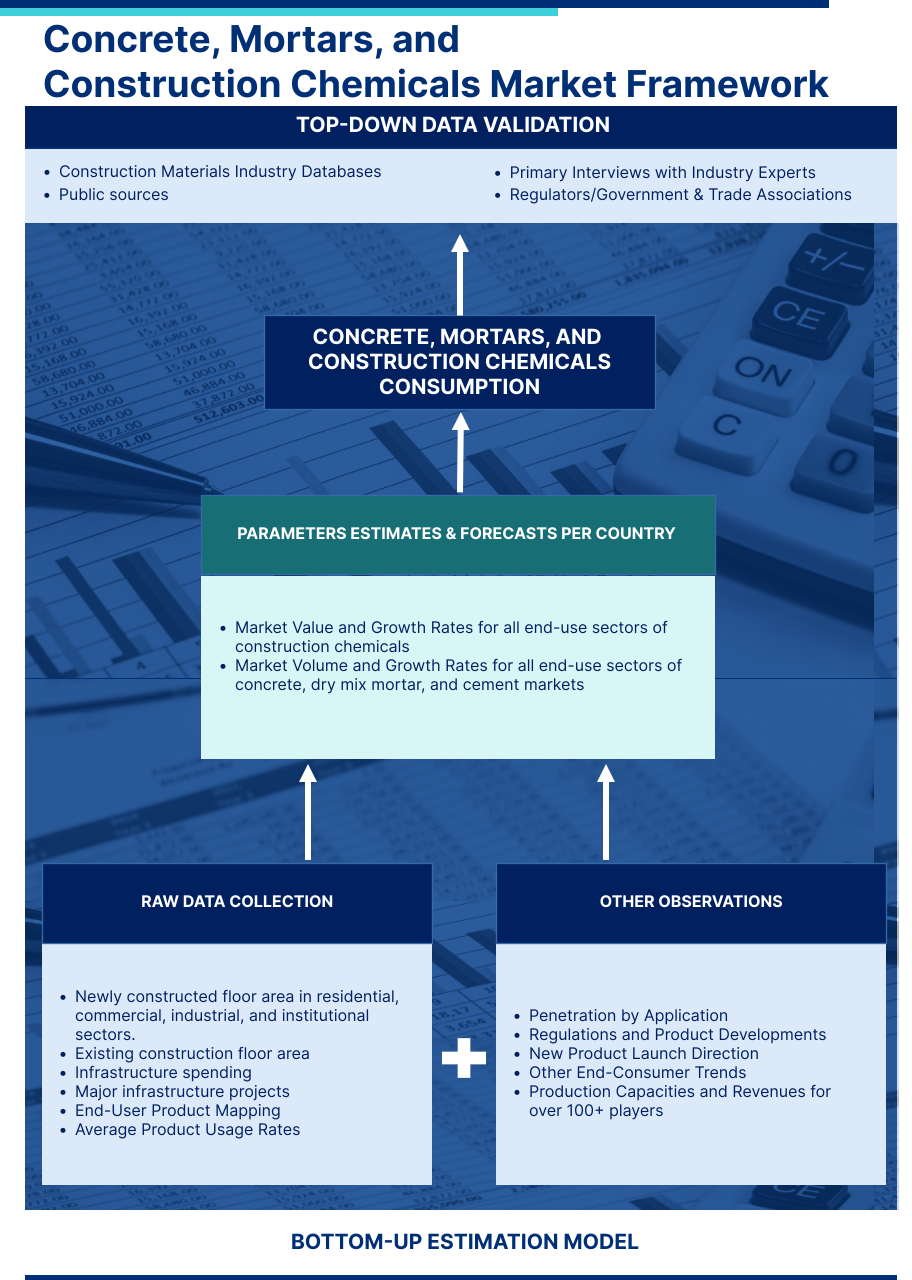
Mordor Intelligence follows a four-step methodology in all our reports.
- Step-1: Identify Key Variables: The quantifiable key variables (industry and extraneous) pertaining to the specific product segment and country are selected from a group of relevant variables & factors based on desk research & literature review; along with primary expert inputs. These variables are further confirmed through regression modeling (wherever required).
- Step-2: Build a Market Model: In order to build a robust forecasting methodology, the variables and factors identified in Step-1 are tested against available historical market numbers. Through an iterative process, the variables required for market forecast are set and the model is built on the basis of these variables.
- Step-3: Validate and Finalize: In this important step, all market numbers, variables and analyst calls are validated through an extensive network of primary research experts from the market studied. The respondents are selected across levels and functions to generate a holistic picture of the market studied.
- Step-4: Research Outputs: Syndicated Reports, Custom Consulting Assignments, Databases & Subscription Platforms
Get More Details On Research Methodology
Download PDF




